Table of Contents
What Makes a Franchise “Beginner-Friendly” for First Time Owners?
Key Factors to Evaluate Before Choosing Your First Franchise
Best Types of Franchises for First Time Owners (and Why Service Wins)
15 Example Franchises That Work Well for First Time Owners in 2026
Why Home-Based, Low-Overhead Models Like CoolVu Are Ideal for First Time Owners
Franchising remains one of the most reliable paths into business ownership for a reason: you get a proven business model, brand recognition, and training that dramatically shorten the learning curve compared to starting from scratch. In 2026, franchise opportunities are more accessible than ever, with home-based and low cost service models opening doors for first time entrepreneurs who want to build something real without betting everything on an unproven concept.
This article walks you through what actually makes the best franchises for first time owners stand out, how to evaluate your options using real financial data, beginner-friendly categories worth exploring, 15 concrete brand examples, and where CoolVu fits into the picture as a home-based surface solutions franchise. The goal is realistic, people-first guidance to help you navigate your franchise journey with confidence – not another generic top-100 list you’ll forget by tomorrow.
What Makes a Franchise “Beginner-Friendly” for First Time Owners?
Not all franchise business concepts are created equal when it comes to welcoming newcomers. The best franchises for first time owners tend to share a specific cluster of traits that reduce risk and accelerate the path to profitability.
Here are the 5–7 characteristics that consistently separate beginner-friendly systems from the rest:
- Simple, repeatable operations. Franchises with simpler business models reduce risk for beginners by eliminating complex regulatory requirements (food safety certifications, heavy inventory management, large staff supervision). Service-based and mobile concepts are inherently easier to learn and operate.
- Strong training and support. Franchises with strong training programs help beginners succeed because they don’t assume you already know the industry. Training programs help franchisees learn the business from the ground up – from installation techniques to sales scripts to back-office software. Many beginner-friendly franchises require no prior industry experience, and brands with experienced leadership teams and comprehensive support give new owners added confidence.
- Ongoing franchisor involvement. Successful franchises often involve structured support from franchisors that extends well beyond launch day. Ongoing support includes operational guidance and marketing assistance, so you’re never figuring things out alone. Franchisors often offer access to a network of fellow franchisees for peer learning and problem-solving.
- Recurring or repeat demand. Industries with built-in repeat business reduce the constant pressure of finding new customers. Mosquito Joe, for example, reports approximately 88% recurring customer rates in its pest treatment model. Window film, surface solutions, senior care, and education all follow similar patterns.
- Low complexity, low overhead. Many beginner-friendly franchises offer turnkey operational systems that work from a home office. Franchises that require no inventory simplify business operations further. No retail lease, no warehouse, no complicated supply chain.
- Reasonable investment thresholds. The best entry points for new franchise owners typically fall between $50,000 and $150,000 in total investment – enough to build a real business without overextending financially.
- Protected territories. Defined geographic boundaries ensure you have enough market to grow without competing against other owners in the same brand.
Key Factors to Evaluate Before Choosing Your First Franchise
Choosing the right franchise requires more than browsing a website and picking something that sounds exciting. Here are the specific factors first time owners should evaluate before signing anything.
Financial reality check. Franchises requiring less than $100k are suitable for beginners seeking lower risk, but you need to understand the full picture. Total investment includes initial fees and ongoing expenses – franchise fee, equipment, working capital, insurance, vehicle costs, and marketing. Ongoing expenses like royalty fees (typically 5–10% of gross revenue) and advertising fund contributions (1–3%) add up. Budget for at least 6–12 months of working capital beyond startup costs. For context, CoolVu’s total investment runs approximately $56,000–$94,000, while TruBlue Home Service Ally ranges from $70,050–$96,400; you can review a detailed breakdown of CoolVu franchise costs to see how one specific investment range is structured. Cash required varies, but expect to need 30–70% of total investment in liquid form.
FDD deep dive. Evaluating the franchise disclosure document is crucial before purchasing a franchise. Item 7 breaks down every startup cost. Item 19 reveals financial performance data – average revenue, job size, closing rates. Item 20 shows system growth and closure rates. Franchisors provide comprehensive training for new franchisees, and franchise fees cover brand rights and initial training, but you need to verify what “training” actually means in practice and how typical franchise costs and ongoing fees line up with your budget.
Operational fit. Are you comfortable being hands-on daily, or do you want a semi-absentee model? Most franchises require full-time owner involvement during ramp-up. Consider staffing needs, hours of operation, and whether the concept is mobile, home-based, or requires a physical location.
Territory and market demand. Market demand varies by region and affects franchise success significantly. A strong brand in the wrong ZIP code still struggles. Look at population density, housing stock, commercial building counts, and local competition. CoolVu, for example, defines territories requiring minimum thresholds of owner-occupied homes and retail businesses.
Scalability and exit. Can the model grow to multi unit ownership? Can you sell the business later? Brands that allow additional territory purchases and have established resale processes give you more long-term flexibility.
Create a scorecard. Compare 3–5 franchise opportunities side by side using a written grid: must-haves, nice-to-haves, and deal-breakers. This eliminates gut-feel decisions and forces clarity.
Best Types of Franchises for First Time Owners (and Why Service Wins)
Rather than chasing the hottest brand name, first time owners should focus on franchise categories that structurally favor beginners.
Service-based franchises often require lower initial investments and simpler daily operations than retail or food concepts. Service-based franchises often have lower startup costs because they avoid expensive build-outs, heavy equipment, and large inventories. Mobile franchises operate without a physical storefront, reducing costs dramatically. Low-cost home-based franchises lack storefront overhead entirely, which is why many of the top service franchise opportunities are built around lean, mobile or home-based models.
Here are the categories showing the strongest fundamentals for beginners in 2026:
- Home services and property maintenance. This sector grows 3–4% annually, driven by aging housing stock and energy efficiency demand. Window film and surface solutions, handyman services, cleaning, and pest control all fit here. Commercial cleaning franchises provide steady, recurring revenue. Service-based franchises often include cleaning and janitorial services as accessible entry points, and proven franchise models in booming home-improvement niches tap directly into trends like energy efficiency and security.
- Senior care and home health. Demographic trends benefit the senior home-care franchise market as the 65+ population continues expanding rapidly. Placement and non-medical care models keep licensing requirements manageable.
- Education and youth enrichment. Structured curriculums appeal to owners in the education franchise sector because the product is already built. Tutoring, STEM programs, and test prep all feature repeat enrollment cycles.
- Pet services. Pet spending continues climbing. Mobile pet grooming and specialty pet food delivery models offer low overhead and loyal customer bases. Mobile-first car detailing models have low overhead too, following the same mobile-service logic in a different vertical.
- Energy efficiency and home improvement. Rising energy costs and building code changes create durable demand for window film, insulation, and surface upgrades in both residential and commercial properties.
The common thread: these categories let you start lean, build relationships locally, and generate repeat revenue without managing a 20-person staff or a fast casual kitchen.
The “best franchise” is subjective – what matters is the match between your skills (consultative sales, project management, people leadership) and your local market’s demand.
15 Example Franchises That Work Well for First Time Owners in 2026
The following brands illustrate the range of franchise opportunities available across industries. These are illustrative examples, not endorsements – your due diligence should include FDD review and franchisee validation for any brand you consider seriously, especially if you’re comparing them with other high-profit, proven franchise opportunities.
Home Services and Property
- TruBlue Home Service Ally – Handyman, yard care, cleaning, senior safety modifications. Cash required: ~$70K–$96K total. Home-based, multiple revenue streams, strong 90-day launch program.
- Mosquito Joe – Seasonal pest control treatments. Cash required: ~$50K liquid. Route-based, high recurring customer rate (~88%), backed by Neighborly group.
- Oxi Fresh Carpet Cleaning – Residential and commercial carpet cleaning. Investment ~$54K–$84K. Simple repeat-service model with established systems.
- Window Genie – Window cleaning, tinting, pressure washing. Home-based operations with residential customers and commercial accounts.
Senior Care and Health
- Caring Transitions – Senior relocation, downsizing, estate sales. Low overhead, growing demographic tailwind, no medical licensing required.
- Always Best Care Senior Services – Non-medical home care and assisted living placement. Investment ~$90K–$146K. Strong brand reputation in the senior care space.
Education and Youth
- Mathnasium – Math tutoring centers. Proven systems with proprietary curriculum. Requires a small retail location but benefits from strong brand recognition and franchisee satisfaction.
- Club Z Tutoring – In-home and online tutoring. Lower investment threshold, home-based concept, flexible scheduling.
Pets and Lifestyle
- Pet Wants – Fresh, custom pet food delivery. Investment ~$70K–$92K. Repeat purchase model with loyal customer base.
- Aussie Pet Mobile – Mobile pet grooming. No storefront needed, mobile operations keep overhead low.
- Cruise Planners – Home-based travel agency. Extremely low startup cost, strong support network, backed by American Express.
Property Inspection and Specialty Services
- Pillar To Post Home Inspections – Home inspection services. Low cost entry, no inventory, strong demand from real estate transactions.
- WIN Home Inspection – Similar model with a proven track record across the country.
- Pool Scouts – Pool cleaning and maintenance. Route-based, recurring revenue, lower investment range.
- Naturals2Go – Healthy vending machines. Semi-passive income potential, low staffing, flexible hours.
Most of these brands fall below $150K total investment. The home-based and mobile options (Cruise Planners, Aussie Pet Mobile, Club Z, CoolVu) require the least capital and carry the lowest fixed overhead, which is why many owners gravitate toward home-based franchise models like CoolVu when they’re just getting started.
Why Home-Based, Low-Overhead Models Like CoolVu Are Ideal for First Time Owners
Many first time entrepreneurs discover that the perfect franchise isn’t a storefront concept at all. Home-based, B2B/B2C service brands like CoolVu eliminate the largest cost centers (rent, build-out, heavy staffing) while preserving strong revenue potential.
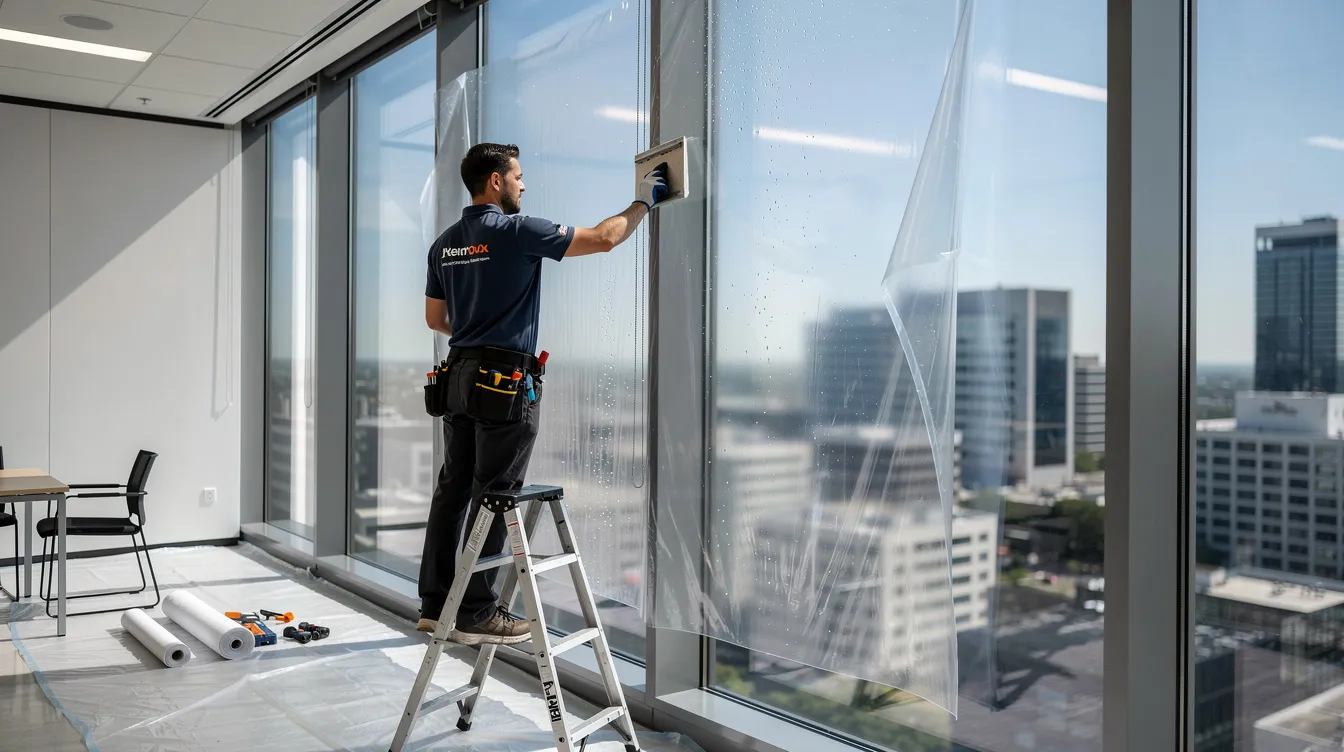
What CoolVu actually does. CoolVu provides glass and surface solutions: window tinting and window film for energy efficiency, security film for impact and break-in protection, privacy solutions for offices and homes, decorative glass and wall graphics, smart and switchable glass films, and architectural surface finishes. This diversity creates multiple revenue streams under one roof – residential homeowners, commercial property managers, healthcare facilities, government buildings, and retail locations all need these services, making it a proven franchise business model in a booming industry.
The business model through a beginner’s lens. CoolVu operates as a home-based franchise with mobile service delivery. Franchises with no real estate overhead are low-risk for new owners, and CoolVu exemplifies this – no retail lease, no warehouse, no showroom required. Protected territories are defined by minimum household and commercial building thresholds, giving each franchise owner a viable market. Initial training typically covers the business model and operations, including technical installation, estimating, sales processes, and marketing execution, aligning closely with the core benefits of franchise ownership that appeal to first-time entrepreneurs.
Investment context. CoolVu typically fits entrepreneurs with around $50,000 in liquid capital. The total investment ranges from approximately $56,000 to $94,000, with a standard franchise fee of $19,900. Veterans can qualify for a waived franchise fee; women, minorities, and first responders often receive 50% discounts. In-house financing options are available, and resources like CoolVu’s investment cost guide can help you understand how those numbers break down.
Performance transparency. CoolVu discloses an average job invoice of approximately $2,700 with a closing rate near 57–58%. Nearly half of existing territories exceed that average. This level of Item 19 transparency helps first time owners build confidence in projected cash flow rather than guessing, and recent franchisee testimonials and reviews echo that the model’s support and earnings potential match what’s presented.
The ideal CoolVu candidate enjoys consultative selling, local relationship-building with homeowners and property managers, and project-based work. If that sounds like your style, it’s worth a closer look.
Common Mistakes First Time Franchise Owners Should Avoid
Every new franchise owner worries about picking the wrong brand or running out of cash too early. The good news: avoiding a handful of common errors dramatically improves your odds of building a rewarding business.
- Underestimating total costs. First-time owners often underestimate total costs by overlooking vehicle wraps, insurance, local permits, travel for training, and the cash needed to operate while revenue ramps. Budget for worst-case scenarios in months 1–6.
- Choosing on brand fame alone. Choosing a franchise based solely on brand recognition is risky. A well-known fast casual restaurant chain might have massive brand awareness but also demands $500K+ in build-out, complex staffing, and razor-thin margins.
- Ignoring local market realities. A top franchises list means nothing if your territory lacks the right demographics. Validate demand in your specific market before committing.
- Skipping FDD and legal review. Skipping proper research can lead to avoidable challenges. Have a franchise attorney review every page of the FDD. Talk to a CPA about projected cash flow, and make sure you understand broader guidance on whether buying a franchise is a good idea for your situation before you sign.
- Not calling existing franchisees. Speak with at least 5–10 current franchise owners. Ask about real startup costs, daily operations, and surprises. This validation step is non-negotiable.
- Assuming semi-passive income from day one. Most franchise ownership demands full-time, hands-on involvement during ramp-up. Plan accordingly.
- Underinvesting in marketing. The franchisor provides materials and strategy, but local marketing (digital ads, community outreach, networking) requires your time and budget for the first 12–24 months.
- No ramp-up plan. Build a realistic 90-day and 12-month plan that assumes slower-than-ideal sales while expenses ramp immediately. Hope for the best, plan for the worst.
How to Start Your Franchise Journey in the Next 90 Days
Rushing the decision process often leads to second-guessing. A deliberate 60–90 day evaluation process builds the foundation for confident franchise ownership. Here’s a clear path forward:
Weeks 1–2: Define your personal and financial goals. How much can you invest? How much do you need to earn? What lifestyle do you want? Determine your liquid capital and narrow to 2–3 industries that match your interests – home services, senior care, education, window film and surface solutions, using an expert guide to the best franchises to buy into as a reference point rather than a shortcut.
Weeks 3–4: Request FDDs from 3–5 brands. Compare Item 7 (costs) and Item 19 (financial performance) side by side. Note royalty fees, ad fund percentages, and working capital requirements as you weigh whether buying a franchise is ultimately worth it given your goals and risk tolerance.
Weeks 5–6: Conduct franchisee validation calls. Ask current business owners about their real experience – startup timeline, profitability, franchisor responsiveness, and what they’d do differently. For example, reading in-depth CoolVu franchise reviews can help you frame the questions you’ll want to ask any brand’s owners.
Weeks 7–8: Attend discovery days. Visit operating territories if possible. Evaluate training deliverables, supply chain relationships, and marketing programs firsthand so you understand exactly what the “how to become a franchise owner” process looks like with any brand, whether that’s CoolVu’s step-by-step ownership path or another system’s.
Weeks 9–10: Build your scorecard. Rank each brand on must-haves (investment fit, territory availability, support quality), nice-to-haves (multi unit potential, semi-absentee option), and deal-breakers, grounding your criteria in a clear understanding of what a business franchise actually is and how it works.
Weeks 11–12: Engage a franchise attorney and CPA. Explore financing options – SBA loans, ROBS providers, or in-house programs like CoolVu’s financing support. Resources such as CoolVu’s franchise FAQ on costs, territories, and incentives can also clarify details before you commit. If everything aligns, begin your application and reserve your territory.

FAQs: Best Franchises for First Time Owners
Do I need industry experience to invest in a franchise? No. Most beginner-friendly systems are designed for people with no prior experience in the specific industry. What matters more is your willingness to learn, follow proven systems, and manage sales, operations, and customer relationships. Franchises with strong training programs increase success rates regardless of your background.
What is a realistic budget for a first-time franchise owner in 2026? For low cost, home-based, or mobile service franchises, expect a total investment between $50,000 and $150,000. Brands like CoolVu ($56K–$94K) and TruBlue ($70K–$96K) sit at the lower end. More complex concepts like fast casual restaurants or fitness studios can exceed $300K–$500K+. When you’re ready to dig into specifics, review a guide to CoolVu’s investment range and fees as one concrete example.
How long does it take to open a franchise and reach break-even? Most service and home-based franchises launch within 3–6 months of signing. Break-even typically occurs within 12–24 months, depending on local demand and owner effort. TruBlue’s disclosed data implies an approximate 2.6-year payback period. Leaner models with lower overhead can reach profitability faster.
Are home-based franchises really easier for beginners? In many respects, yes. You avoid lease obligations, retail build-out costs, and higher fixed monthly expenses. But “easier” doesn’t mean “effortless.” You still manage logistics, marketing, customer relationships, and potentially a small team. The advantage is financial flexibility and lower downside risk.
How do I compare two franchise options that both look good? Use FDD data as your foundation. Compare Item 7 investment ranges, Item 19 revenue by quartile, royalty and ad fund burdens, and closure rates (Item 20). Layer in franchisee satisfaction scores and lifestyle fit. The brand that wins across your personal scorecard – not just the one with the best marketing – is usually the right franchise for you, whether you ultimately choose a franchise or build a non-franchise business.
Can I start part-time, or should I plan to go full-time? Most franchisors expect full-time involvement during the first 12–18 months. Some consulting, vending, or travel-planning models allow part-time starts, but this is the exception. Ask the franchisor directly and validate with existing franchisees before assuming you can operate part-time.
Is CoolVu a good franchise opportunity for first time owners? For those with approximately $50,000 in liquid capital who want a home-based, low-overhead service franchise, CoolVu checks nearly every beginner-friendly box: strong initial training and ongoing support, protected territories, multiple revenue streams (window film, decorative graphics, surface finishes), transparent performance metrics (average job invoice ~$2,700, ~57% closing rate), and veteran/minority/first responder discounts. The key success predictors are comfort with consultative selling, local relationship-building, and hands-on project work – especially early in your career as a franchise owner, which is why many lists of the best franchises to buy in the mid-2020s highlight CoolVu as a standout.
Why Choose CoolVu When You’re Comparing the Best Franchises for First Time Owners
CoolVu exists at the intersection of several durable trends – energy efficiency, building security, privacy, and aesthetic upgrades – all delivered through a low-overhead, home-based business model that first time entrepreneurs can actually succeed in.
Unlike complex franchise concepts that demand six-figure build-outs, large teams, and years of industry knowledge, CoolVu gives you a clear path to revenue with comprehensive training, marketing support, in-house financing, and protected territories. You serve both residential customers and commercial clients, which diversifies your demand and insulates you from seasonal slowdowns. The investment is accessible, the operations are straightforward, and the market for surface and window solutions continues to grow across the country, putting CoolVu alongside other top franchises to buy right now for entrepreneurs who want service-based models.
Consider a scenario: a veteran transitioning out of military service uses CoolVu’s waived franchise fee and comprehensive training to launch a home-based operation within 90 days. Or a corporate professional tired of the cubicle life invests $50K in liquid capital, completes training, and starts generating revenue from local homeowners and commercial property managers within the first quarter. These aren’t hypothetical – they reflect the profile CoolVu was built for and closely mirror the stories shared in CoolVu franchisee testimonials and reviews.
If you’re evaluating the best franchises and want a concept that combines low risk, strong ROI potential, and a rewarding business you can grow on your own terms, CoolVu deserves a spot on your shortlist.
Ready to find out if CoolVu fits your goals, capital, and local market? Download the CoolVu franchise information kit or schedule a franchise discovery conversation today. Your franchise journey starts with a single conversation – make it count.