Table of Contents
Why a Commercial Energy Savings Franchise Matters in 2026
How a Commercial Energy Savings Franchise Creates Energy and Cost Savings
Owning a CoolVu Commercial Energy Savings Franchise: Model, Training, and Revenue Streams
Real-World Energy Savings, Incentives, and What to Expect as a New Franchisee
Frequently Asked Questions
Why a Commercial Energy Savings Franchise Matters in 2026
A commercial energy savings franchise sells, installs, and services technologies that improve energy performance in commercial buildings. CoolVu’s model centers on window film, tinting, smart glass, decorative finishes, and architectural surface solutions that reduce a building’s energy use and cut operating costs without major construction. Franchises specializing in commercial energy savings help businesses reduce energy consumption, and investing in a commercial energy savings franchise offers a turnkey entry into a high-demand sector that keeps growing.
Why does this matter right now? Since 2022, electricity rates across major U.S. metros have climbed sharply. Between 2020 and 2025, roughly 97.5% of commercial facilities experienced rate increases, with 71% seeing hikes that outpaced inflation. At the same time, stricter building codes like ASHRAE 90.1-2022 are pushing states to tighten commercial envelope requirements by 2026. There is an increasing focus on sustainability driving businesses to seek energy efficiency, and corporate ESG goals are adding urgency. The commercial energy-efficiency market is dominated by independent engineering firms and ESCOs, but franchise models like CoolVu are creating a more accessible entry point for entrepreneurs.
CoolVu franchisees help commercial customers reduce heat gain, glare, and HVAC load using energy efficient window film, smart switchable glass, and architectural finishes. This is a low-overhead, home-based franchise that serves small business storefronts, retail chains, healthcare clinics, schools, and government facilities with measurable energy savings and strong cash-flow potential. In the sections ahead, you will learn how the business creates savings, how the franchise model works, what incentives and rebates can accelerate deals, real-world success stories, and why CoolVu stands out in the commercial energy savings space.
How a Commercial Energy Savings Franchise Creates Energy and Cost Savings
The core value a commercial energy savings franchise delivers comes down to measurable reductions in energy costs. CoolVu’s services target the building envelope, specifically the glass, using solar control window film, low-emissivity coatings, and smart glazing to reduce the amount of heat entering a space. The result is lower cooling loads, less strain on HVAC systems, and improved occupant comfort.
Here is how each mechanism works in practice:
Solar Heat Gain Control and Insulation
Commercial window film blocks near-infrared and UV radiation before it passes through glass, which directly reduces the cooling load on a building’s HVAC system. Low-e films add a radiant heat barrier that works in both summer and winter, reducing the amount of heat transferred through glazing in either direction. Energy-efficient equipment like high efficiency HVAC systems runs less frequently when solar heat gain is controlled at the glass, which means businesses save money monthly on electricity and maintenance.
Typical benchmarks show cooling load reductions of 15 to 30 percent in commercial spaces with significant glazing, especially on south- and west-facing exposures. In real-world projects, payback periods for solar control or low-e film range from about 2 to 7 years depending on climate, glass type, and local utility rates. Energy efficiency upgrades often pay for themselves through reduced energy bills within this window.
Glare, UV, and Comfort
Beyond energy saving, controlling glare and blocking UV light protects interior furnishings, flooring, and merchandise from fading. Occupants in offices, clinics, and classrooms report better visual comfort, which reduces complaints and can improve productivity. This is not just about saving a few dollars on electricity. It changes how a space feels throughout the day.
Complementary Upgrades That Multiply Savings
Smart thermostats help control energy usage in commercial spaces by responding to real-time conditions rather than fixed schedules. Many franchisees deploy smart building controls like IoT sensors and automated thermostats alongside window film installations to maximize the energy saving impact. Replacing inefficient lighting can significantly reduce energy consumption, and energy recovery ventilators improve air quality and save money by capturing waste heat from exhaust air. High-efficiency HVAC systems can earn rebates for businesses when combined with envelope improvements like window film. Taken together, these measures create a layered approach to reducing energy use that goes well beyond “just tinting.”
Where the Savings Apply
CoolVu solutions work for both an existing building and new construction:
- In retrofit scenarios, applying film to existing glazing can meet updated energy code targets without replacing entire window systems, an affordable alternative to full window replacement.
- In new construction or renovation, specifying spectrally selective films or switchable glass during design helps buildings exceed ASHRAE 90.1-2022 prescriptive and performance requirements.
Franchises typically help commercial customers reduce utility costs through energy audits and upgrades. Commercial energy savings firms often target office buildings and healthcare facilities, but the opportunity extends to any building with problematic glass. Franchises also focus on sectors with high energy consumption, such as manufacturing and hospitality, where solar exposure through skylights and large windows drives significant cooling demand.
Typical Commercial Clients
| Client Type | Common Pain Points | Typical Glazing Area |
|---|---|---|
| Small business storefronts | Glare, hot spots, fading merchandise | 500–3,000 sq ft of glass |
| Multi-tenant office buildings | Uneven temperatures, tenant complaints | 5,000–50,000+ sq ft |
| Medical and dental practices | Patient comfort, equipment protection | 1,000–5,000 sq ft |
| Schools and universities | Classroom glare, aging windows | 10,000–100,000+ sq ft |
| Government facilities | Code compliance, energy mandates | Varies widely |
Positioning Services as Energy Management
The key to winning commercial work is to position your services as part of a broader energy management strategy, not as commodity window tinting. Franchises typically combine energy auditing and ongoing monitoring for significant savings, and this consultative approach is what separates a commercial energy savings franchise from a generic tint shop.
A simple before-and-after example makes the impact tangible. A 10,000 square foot office with $4,500 in monthly summer cooling costs might see a 20% reduction after film installation, saving roughly $900 per month during peak season. Over a full year, that translates to $5,000 to $8,000 in savings, depending on climate zone and utility rates. When you run the numbers for a building owner, the conversation shifts from “how much does it cost” to “how fast does it pay for itself.”
CoolVu franchisees help business owners leverage utility rebates and cash incentives for energy efficient window treatments, smart thermostats, and related measures when available in their state or city. Many franchises offer multiple service options such as audits and equipment installation, giving franchisees a variety of ways to create value per project.
Owning a CoolVu Commercial Energy Savings Franchise: Model, Training, and Revenue Streams
CoolVu is a home-based, low-overhead franchise designed for owner-operators and small teams who want to serve both commercial and residential customers with a strong focus on commercial energy savings. Commercial energy savings franchises generally operate as B2B consultancies, and CoolVu fits this profile while also offering direct-to-consumer residential work that helps smooth revenue across slower commercial months.
Startup Profile
Getting started with CoolVu looks different from most brick-and-mortar franchises:
- Liquid capital requirement: Approximately $50,000, making it accessible to a range of entrepreneurs seeking an affordable entry point.
- Operations: Home-based. No showroom, no lease on retail space. Your key investments go toward tools, materials, a service vehicle, training, and marketing.
- Territory: Protected territories covering defined commercial districts, suburbs, and surrounding communities. You own a specific site and build your client base within it.
This model keeps fixed overhead low, which protects margins and lets you reinvest in growth. Franchisees benefit from the franchisor’s established operational procedures and training, so you are not building a business from scratch.
Revenue Streams
A CoolVu franchise is not a one-product business. Here are the primary revenue lines:
- Solar control window film installation – the core energy saving service for commercial and residential glass.
- Security and privacy films – for offices, storefronts, government buildings, and healthcare facilities that need to protect occupants and assets.
- Decorative glass and wall graphics – branded finishes, frosted privacy patterns, and interior design treatments.
- Architectural surface finishes – re-skinning walls, elevator interiors, and other surfaces with durable, aesthetic materials.
- Smart and switchable glass solutions – dynamic glazing that changes tint or opacity on demand, a growing category in new energy technology.
This variety of services means you can offer solutions across a wide range of commercial needs. Franchisees act as middlemen between clients and wholesale energy suppliers in deregulated markets when coordinating broader energy strategies, and many energy savings franchises offer ongoing monitoring and maintenance services that generate recurring revenue.
Recurring and Scalable Revenue
Commercial work scales naturally. A single relationship with a property management firm can open the door to projects across an entire portfolio. Multi-location retail chains, healthcare systems, and school districts often phase upgrades across buildings over months or years. Each completed project becomes a proof point for the next.
Training and Support
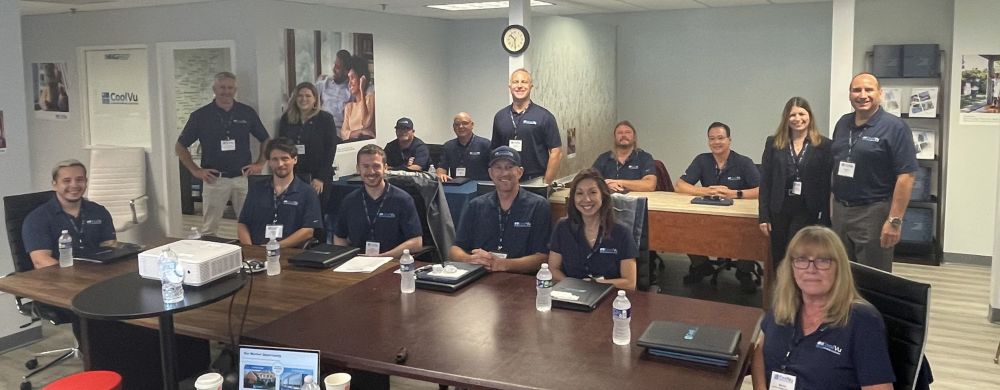
CoolVu’s training program covers the full range of skills a franchisee needs:
- Technical training: Film installation, surface prep, glass handling, quality control, and working with different glazing types.
- Sales training: How to run energy efficiency conversations, present ROI projections, and connect with facility managers, architects, and contractors as referral partners. Franchisors provide training covering energy auditing and sales techniques so you can confidently walk a building owner through the numbers.
- Estimating tools: Access to tools that model solar exposure, glazing specs, and utility rates to generate credible energy saving projections using past project data and manufacturer performance specs.
- Marketing and lead generation support: Digital campaigns, local SEO strategy (so your business shows up when someone opens their browser and searches for commercial window film or energy savings in your area), and co-branded materials that emphasize energy savings.
Franchise networks often have knowledge of local utility incentives covering project costs, so your team can help clients find and apply for programs that reduce upfront costs and improve close rates.
Who This Franchise Fits
The CoolVu model fits veterans, first responders, women, and minority entrepreneurs seeking a flexible schedule. Weekday hours are typically dedicated to commercial work, while optional weekend residential projects add a secondary revenue line. Many franchise programs offer discounts or funding assistance for eligible candidates from these groups.
CoolVu franchisees can present simple ROI and energy saving projections to help commercial clients justify upgrades within their capital budgets. This is not guesswork. It is a data-driven conversation backed by real installation results and product performance specs that help you stand out from every other participating contractor in the market.
Real-World Energy Savings, Incentives, and What to Expect as a New Franchisee
This section makes the opportunity concrete with typical project types, success stories, and a look at how incentives can accelerate your deals and your clients’ decisions.
Success Stories That Show What Is Possible
Real projects illustrate the range of outcomes a commercial energy savings franchise can deliver:
- Campus retrofit, Temple College (Texas): A 30,000 square foot campus retrofit using low-e window film delivered approximately $33,900 per year in documented savings. The combined ROI was about 3.6 years, with individual buildings achieving payback as fast as 1.3 years depending on existing conditions. This is the kind of project that becomes a centerpiece of your local marketing.
- Regional bank, Phoenix (Arizona): A solar control film installation across multiple branch locations saved an estimated 747,000 kWh per year, roughly $74,000 annually in avoided electricity costs, with payback under 5 years. The project leveraged utility rebates from the local provider to reduce upfront project costs. These kinds of success stories are what win over skeptical facility managers.
- Mixed-use complex, San Francisco: A large commercial property installed advanced solar control film that reduced solar heat by up to 59%, UV by up to 99%, and glare by up to 72%. Estimated annual cost savings exceeded $350,000, with payback projected at 3 to 5 years.
These are not outliers. They represent the kind of outcomes that are achievable when you match the right product to the right building.
How Incentives and Rebates Work
One of the biggest deal accelerators in this business is helping your clients tap into incentives and rebates that reduce their out-of-pocket costs:
- Utility rebate programs: Many utilities offer cash incentives for qualifying window films, smart thermostats, and envelope improvements. Austin Energy offers rebates for energy-efficient HVAC upgrades, and rebates for smart thermostats can reach up to $75 in some programs. Free lighting upgrades are available for eligible small businesses in many service territories.
- Energy Savings for Business programs in several states cover up to 70 percent of project costs. Incentives can cover up to 70% of project costs for small businesses, which dramatically changes the payback math.
- Federal tax benefits: The IRS 179D deduction allows commercial building owners to claim deductions for energy-efficient upgrades. Buildings placed in service after 2026 must reference newer ASHRAE standards, making code-compliant retrofits even more valuable.
- State and local programs: EmPOWER Maryland saved $14.5 billion since 2008 through a combination of utility-funded efficiency programs. EnergyDirect helps businesses manage electricity usage efficiently in deregulated markets. Small businesses can receive cash incentives for energy-efficient upgrades in dozens of states. Cash incentives help reduce upfront costs for energy-efficient upgrades, making the decision easier for budget-conscious owners.
Availability varies by state and utility, but CoolVu franchisees are trained to help clients identify which programs they qualify for and how to apply. This is a real differentiator. Most “tint shops” never even mention rebates.
Typical Commercial Project Workflow
Here is what a typical commercial project looks like from start to finish:
- On-site assessment: Visit the building, measure glazing areas, assess glass type, shading, orientation, and current energy use. Energy auditing involves on-site assessments to evaluate HVAC systems and lighting efficiency, giving you a complete picture.
- Energy and comfort discussion: Talk with the owner or facility manager about heat, glare, occupant complaints, and budget. Learn what matters most to them.
- Proposal with estimated savings: Present a written proposal that includes product recommendations, estimated energy savings, project costs, applicable rebates, and projected payback period.
- Installation: Schedule the work to minimize business disruption. Many commercial installations happen after hours or on weekends.
- Post-install check-in: Follow up to measure results, gather feedback, and document before-and-after conditions for future marketing.
What Small Business Owners Should Know
Even a 1,500 to 3,000 square foot storefront can benefit from glare control and reduced solar heat gain. In a hot climate with high utility rates, a small business can sometimes achieve a simple payback in 3 to 5 years when incentives are layered in. The key is matching the right film to the specific glass and exposure. Not every window needs the same solution, and a good franchisee will never recommend more than what the building actually needs.
Practical Expectations for New Franchisees
If you are considering a CoolVu franchise, here is what to expect in the early months:
- Ramp-up period: The first 6 to 12 months will be focused on building your pipeline. Networking with local chambers of commerce, real estate groups, and commercial property managers is how you get started. Focus early outreach on high-visibility commercial corridors where building owners can see the impact of your work.
- Month-by-month growth: As you complete projects and collect documented results, each one becomes a tool for winning the next. Commercial decision-making cycles can run 3 to 6 months, so patience and consistent follow-up matter.
- Information is your edge: The more you learn about local codes, incentive programs, and building types in your territory, the more valuable you become to every client.
Common Mistakes to Avoid
- Underpricing commercial labor. Accurately account for overhead, travel, and scheduling when you build your proposals. Thin margins do not create a sustainable business.
- Ignoring decision-making timelines. Facility managers and property owners operate on budget cycles. Do not expect instant closes on large projects. Stay in the pipeline and follow up consistently.
- Failing to document before-and-after conditions. Photos, comfort measurements, and energy bill comparisons are your most powerful marketing assets. Without them, you are asking prospects to take your word for it.
- Not helping clients apply for incentives. If you skip this step, you leave money on the table and make your proposal less competitive.
Using Success Stories to Win Bigger Projects
Documented success stories, including photos, testimonials, and energy bill comparisons, are what separate a professional commercial energy savings franchise from a generic install shop. When a facility manager can see that you delivered measurable savings on a similar building in their area, the conversation changes. You move from “vendor” to “trusted advisor,” and that is the line between one-off projects and long-term relationships.
Frequently Asked Questions
What is a commercial energy savings franchise?
A commercial energy savings franchise is a business model where franchisees provide energy-reducing products and services to commercial buildings. CoolVu franchisees install solar control window film, smart glass, security film, decorative finishes, and architectural surface solutions that lower utility costs and improve efficiency. Commercial energy savings franchises help businesses lower utility costs and improve efficiency across a wide range of building types.
How much does it cost to start a CoolVu franchise?
CoolVu requires approximately $50,000 in liquid capital. The business runs from home with no showroom or retail lease required, keeping startup and ongoing overhead low. Funding assistance and discounts may be available for veterans, first responders, women, and minority entrepreneurs.
What kind of savings can commercial clients expect?
Savings depend on climate, glass type, building orientation, and local utility rates. Typical cooling load reductions range from 15 to 30 percent for buildings with significant glazing. Payback periods generally fall between 2 and 7 years. Energy-efficient equipment can save businesses money monthly, and layering in rebates and incentives can shorten payback significantly.
Do utility rebates and incentives really make a difference?
Yes. In many markets, utility programs and state incentives cover a meaningful share of project costs. For example, some programs cover up to 70 percent of eligible costs for small businesses. Austin Energy offers rebates for energy-efficient HVAC upgrades that can be paired with window film projects. Rebates for smart thermostats can reach up to $75. Your CoolVu franchise team is trained to help clients navigate and apply for these programs.
Can CoolVu services work on older buildings with single-pane glass?
Absolutely. Older buildings with single-pane or aging double-pane glass often see the largest improvements from solar control or low-e film. Retrofit window film is one of the most cost-effective ways to improve the energy performance of an existing building without the disruption and expense of full window replacement.
What ongoing support does CoolVu provide after launch?
CoolVu provides ongoing coaching, marketing support, technical resources, and access to estimating tools that help you efficiently run your business. Many energy savings franchises offer ongoing monitoring and maintenance services, and CoolVu’s operational support is designed to help you scale from your first project to a full commercial pipeline.
Why Choose CoolVu
CoolVu is not just a window film installer. It is a commercial energy savings franchise built for the 2026 market. Here is what sets it apart:
- Low overhead, high flexibility. A home-based model means your money goes into revenue-generating activities, not rent. You can run your business efficiently from day one.
- Broad product portfolio. From solar control film to smart switchable glass to architectural surface finishes, CoolVu offers a wider range of solutions than most competitors. This lets you serve a variety of commercial and residential needs without referring work elsewhere.
- Data-driven sales approach. CoolVu gives franchisees estimating tools and past project data to present credible ROI projections. You do not just sell a product. You help commercial customers make informed decisions backed by real numbers.
- Training that covers the full business. Technical skills, sales techniques, code compliance, incentive navigation, and marketing are all part of the program. Franchisors provide training covering energy auditing and sales techniques so you can walk into any commercial building with confidence.
- Support for diverse entrepreneurs. The franchise is designed to fit veterans, first responders, women, and minorities, with flexible scheduling and accessible capital requirements.
- Growing market tailwinds. The U.S. window film market reached approximately $3.35 billion in 2025 and is projected to grow at about 6.1% annually through 2033. New energy codes, rising electricity rates, and corporate sustainability goals are driving demand higher every year. You are entering a market with strong, structural growth behind it.
CoolVu franchisees connect with commercial clients who need real solutions, not generic upgrades. If you want to own a business that delivers measurable value and operates in a sector with durable demand, this is the page to start on.
Take the Next Step
If you are ready to explore what a commercial energy savings franchise can look like in your market, contact the CoolVu team to request franchise information or schedule a discovery call. Visit the CoolVu website to learn more about territories, training, and what it takes to get started. The demand for energy-efficient commercial solutions is not slowing down. The question is whether you will be the one delivering them.