Table of Contents
Why Healthcare Facilities Need Specialized Service Partners
What “Healthcare Facility Services” Actually Includes
Comparing Healthcare Franchises: Clinical Care vs. Facility Services
How a Healthcare Facility Services Franchise Works Day-to-Day
Key Benefits for Hospitals, Clinics, and Home Care Offices
A healthcare facility services franchise is a specialized business that supports hospitals, clinics, urgent care centers, dental practices, and home care offices with non medical but mission-critical services. Think privacy solutions, safety upgrades, cleaning services, energy efficiency, and environment enhancement rather than direct patient care.
The U.S. healthcare franchise industry includes 80 opportunities across eight categories, ranging from clinical care franchise models to facility-focused operations. This article answers two questions: Is a healthcare facility services franchise right for me? And how do brands like CoolVu support healthcare facilities in 2026?
Demand for healthcare services is driven by aging populations and chronic disease management. With an aging population, the demand for home healthcare and specialized services is high, and that pressure extends to the buildings where care happens. Clinical healthcare franchises like fyzical therapy centers, American Family Care urgent care clinics, and home care franchise brands deliver direct medical attention. Non-clinical facility services franchises like CoolVu improve patient safety, privacy, and comfort without providing care itself. Consider a regional health system using a facility services franchise to standardize privacy window films and protective wall finishes across 10 outpatient clinics, creating a consistent, compliant experience for patients and staff alike.
Why Healthcare Facilities Need Specialized Service Partners
Modern healthcare settings operate under strict regulatory, safety, and patient experience pressures. Generic vendors who serve retail or office buildings often miss the specific requirements of medical environments, making specialized partners essential.
Key drivers pushing healthcare facilities toward franchise partners include:
- Infection control and surface hygiene. Hospitals, urgent care centers, dental offices, and senior care facilities must maintain surfaces that withstand hospital-grade disinfectants. The healthcare sector is often recession-resistant as it provides essential services, but that also means buildings see constant use and wear.
- Privacy regulations. HIPAA requires reasonable physical safeguards to prevent unauthorized disclosure of patient information. Glass, windows, and partitions must be designed or treated accordingly.
- Energy and cost pressures. Facilities open long hours, such as American Family Care urgent care clinics operating seven days a week, face significant heating and cooling costs that solar-control films can reduce.
- Security concerns. ERs, behavioral health units, pharmacies, and pediatric wings need shatter-resistant glass and reinforced entry points.
- Patient satisfaction. How safe, private, and comfortable a space feels directly affects online reviews and patient outcomes.
Healthcare service businesses typically face stringent regulatory compliance and operational guidelines. A healthcare facility services franchise brings standardized processes, trained technicians, and vetted products that align with these needs far better than ad-hoc local vendors. The range of facility types served spans imaging centers, ambulatory surgery centers, home health and hospice offices, medical offices, and senior living communities. In a market where 10,000 people turn 80 every day in the U.S. and 89% of Americans over 50 wish to age at home, the buildings supporting older adults and their care teams must perform at a higher standard.
What “Healthcare Facility Services” Actually Includes
This section defines core service categories a healthcare facility services franchise provides. These are tangible building and surface enhancements, not medical procedures, medical staffing, or skilled nursing services.
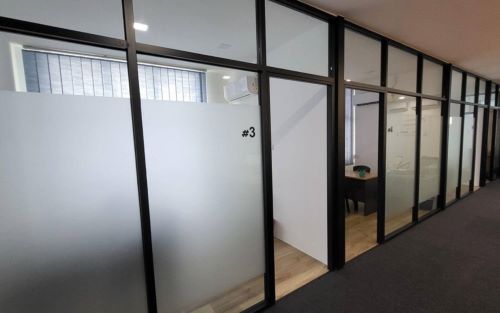
- Glass and window solutions. Solar-control window tinting, privacy films for exam rooms, security films on entry doors, and anti-glare coatings for waiting rooms where patients and healthcare professionals interact with screens.
- Architectural surface finishes. Durable, cleanable wall coverings and door wraps for nurse stations, reception desks, and high-touch corridors. These surfaces must survive repeated disinfection without peeling or degrading.
- Decorative graphics and wayfinding. Branded wall graphics, floor markers, and visual cues that help patients navigate a clinic or hospital. Materials resist fading under UV exposure and cleaning chemicals.
- Smart and switchable glass. On-demand privacy in consultation rooms, procedure rooms, and behavioral health interview spaces using electrically switchable film.
- Safety and security upgrades. Impact-resistant films for pharmacy windows, pediatric areas, and street-level clinics that slow forced entry and protect staff.
- Comfort and energy efficiency. Reducing heat and UV in sun-facing patient rooms and lobbies. A 15,000 sq ft outpatient clinic, for example, can cut summer cooling costs by roughly 20% after installing solar window film and updating finishes in high-traffic corridors.
While healthcare facility services can include medical staffing, home healthcare support, and medical equipment management in some franchise systems, CoolVu focuses specifically on the building envelope. Healthcare facility services franchises cater to hospitals, clinics, and long-term care facilities, providing services to improve patient care environments and enhance the spaces where immediate care and quality care happen daily.
Comparing Healthcare Franchises: Clinical Care vs. Facility Services
The healthcare industry offers franchise owners two fundamentally different paths: clinical care and facility services.
Clinical franchises employ or contract healthcare professionals, including nurses, therapists, physicians, and aides. Brands like FYZICAL therapy centers, American Family Care urgent care locations, and home care franchises such as Home Instead (the largest senior care franchise globally) or Home Helpers deliver direct personalized care and personal care to patients. Physical therapy alone is projected to reach $128 billion by 2032. The Joint Chiropractic has over 800 locations nationwide, often using a membership model. These businesses face medical billing complexity, healthcare staffing demands, and payer mix risk. Home care franchises can achieve an average gross profit margin of 35%, but employee recruitment and retention are major challenges in healthcare services. Senior care franchises are worth $11 billion in the U.S., with approximately 11,500 senior care businesses operating across the country. Urgent care franchises like AFC serve patients of all ages, and urgent care franchises can generate quick returns on investment under the urgent care model. The senior care industry, companion care providers, and healthcare staffing firms including organizations like ATC Healthcare Services all deal with staffing shortages and the operational challenges of delivering high quality care at scale.
Facility services franchises like CoolVu work B2B with hospitals, dental clinics, senior living, and home care offices. They enhance healthcare facilities with window films, architectural finishes, privacy and safety solutions. No clinical licensure required. No insurance billing. The initial investment for healthcare franchises starts at $25,000 across the industry, and facility-focused models often sit at the lower end of startup costs compared to clinical operations.
| Aspect | Clinical Franchise | Facility Services Franchise |
|---|---|---|
| Startup costs | Higher (equipment, location, staff) | Lower (home-based, mobile crews) |
| Staffing | Licensed clinicians, high payroll | Installation teams, fewer regulatory hurdles |
| Revenue model | Insurance billing, patient visits | B2B project sales, recurring revenue stream |
| Clinical risk | Malpractice, compliance, payer risk | Building codes, product performance |
| Who does each path suit? Healthcare professionals wanting to run a practice or home care services operation may lean clinical. Entrepreneurs who want to own their own business supporting healthcare without clinical complexity will find a healthcare facility services franchise like CoolVu a unique opportunity. |
How a Healthcare Facility Services Franchise Works Day-to-Day
Franchise owners in this space split their time between sales, project management, quality control, and relationship building with administrators of hospitals, medical offices, and home health agencies. Healthcare facility services can thrive based on strong relationships with healthcare providers.
The service lifecycle looks like this:
- Initial outreach. Meeting a clinic manager or facilities director to assess specific needs: privacy gaps, patient comfort complaints, glare on EMR screens, or security concerns at entry points.
- On-site assessment. Measuring glass, inspecting surfaces, reviewing traffic patterns, and checking sunlight exposure in waiting rooms and treatment areas.
- Proposal and solution design. Presenting products like solar film, frosted privacy films, or antimicrobial-friendly surfaces. Project phasing is planned to minimize disruption to patient care.
- Installation scheduling. Work happens during off-hours, weekends, or low-volume clinic times. For example, installing privacy film in exam rooms at an urgent care clinic over two consecutive Sunday evenings keeps operations uninterrupted.
- Post-installation verification. Walkthrough with the client, staff training on maintenance, and documentation for compliance files.
Healthcare facility services franchises require adherence to healthcare laws and regulations. Licensing and credentialing are critical for operating a healthcare facility services franchise, and healthcare facility services franchises must secure state and local licenses. Owners use a home-based office model with mobile crews traveling to clients, keeping low overhead costs while maintaining high responsiveness. The highly skilled installation work demands attention to infection control protocols and facility-specific systems.
Key Benefits for Hospitals, Clinics, and Home Care Offices
Decision-makers evaluating facility service partners should understand these concrete benefits:
- Infection-conscious surfaces. Smooth, durable finishes and glass that medical cleaning teams can disinfect repeatedly. These complement existing protocols and reduce fomite reservoirs, contributing to better patient outcomes in healthcare settings.
- Privacy and dignity. Window films prevent line-of-sight into exam rooms, intake desks, and home care consultation spaces, reinforcing HIPAA compliance and patient trust. This matters for patient safety across every clinic type.
- Staff comfort and productivity. Reduced glare on EMR screens and improved temperature control in nurse stations and physician offices. Healthcare professionals spend fewer minutes adjusting blinds or relocating workstations.
- Energy and cost savings. Solar-control films can reduce perimeter zone energy use by roughly 29% in modeled buildings. A small outpatient surgery center might save several thousand dollars annually on cooling alone.
- Branding and patient experience. Cohesive graphics and finishes make even small urgent care and fyzical therapy clinics feel professional and calm.
- Security enhancement. Shatter-resistant films protect staff in pharmacies and after-hours clinics.
Healthcare service franchises may offer recurring revenue through ongoing service contracts as facilities update, expand, or refresh their spaces. Healthcare facility services franchises license an established brand to deliver healthcare-related services, giving clients confidence in consistent quality. A senior care facility updating common areas or a hospice wing improving privacy and natural light balance are typical projects that demonstrate the growing demand for these investment opportunities.
Franchise Ownership: Investment, Training, and Support
For prospective franchise owners exploring healthcare franchise opportunities without launching a clinical practice, CoolVu offers a low cost, low overhead home-based franchise entry point. Total investment ranges from approximately $56,000 to $94,000, with liquid capital expectations around $50,000, and prospective owners can review a detailed guide to CoolVu franchise investment costs. The franchise fee is $19,900, with discounts available for veterans, women, minorities, and first responders, who can also benefit from a broader understanding of how franchise fees work and why franchisors charge them. Home-based operations eliminate the need for expensive retail leases.
CoolVu provides comprehensive training covering window film installation, tinting, decorative graphics, and architectural finishes, with modules tailored to healthcare facilities’ specific needs, backed by an experienced franchise leadership team and mission-driven history. Sales and marketing coaching focuses on approaching hospitals, urgent care brands, dental practices, and home care agencies. Ongoing support includes project estimating tools, vendor relationships, and healthcare-specific marketing collateral, positioning CoolVu among top service franchise opportunities in glass and surface solutions. Franchisees in healthcare services receive specialized training in operational and regulatory areas. Franchisors provide operational support and marketing to franchisees in healthcare services.
The franchise model provides standardized operating procedures, training, and support, reducing startup risks, and prospective owners should understand the typical costs involved in buying and operating a franchise. Franchise systems offer proven processes and protocols for operations. Franchisees benefit from established branding and market penetration. Healthcare franchises often provide access to national marketing support, and franchises help navigate the complexities of the healthcare industry. Franchises often have lower financial risk for bank funding, and the franchise disclosure document must be carefully reviewed before signing a franchise agreement; CoolVu also outlines typical costs and financing options for its own franchise investment.
Unlike labor-heavy home care franchise or medical office cleaning operations, CoolVu requires smaller installation teams, more predictable scheduling, and fewer overnight shifts, which is further detailed in their overview on how to start a CoolVu window film franchise. New franchisees appreciate that healthcare facility work can be one of several verticals alongside retail, education, and government, creating multiple revenue streams and a diversified business.
Why Healthcare Providers Choose CoolVu for Facility Services
CoolVu is not a clinical healthcare franchise. It is a trusted facility solutions brand with an innovative approach, serving healthcare facilities across North America with a proven track record.
- Healthcare-aware product mix. Films and finishes compatible with frequent disinfection, strong cleaning agents, and high-traffic medical environments.
- Experience across building types. From small home care franchise offices and pediatric clinics to multi-story medical office buildings and ambulatory surgery centers.
- Minimal disruption. Installation planning respects clinic hours, infection control, and patient flow, including after-hours and weekend project options.
- Established brand stability. National brand, vetted suppliers, and consistent standards versus one-off local contractors. CoolVu has grown to over 120 territories nationwide.
- Veteran- and first-responder-friendly franchise model. Fee waivers and discounts align with healthcare culture and mission-driven environments, supported by CoolVu’s broader veteran-focused franchise ownership program.
- Flexible B2B and B2C solutions. Ability to serve healthcare workers’ homes with privacy and energy-efficiency upgrades alongside institutional projects.
With an average job invoice of approximately $3,084 and a closing rate near 58%, CoolVu franchise owners build sustainable businesses that deliver high quality care for the built environment where patients receive treatment, as reflected in franchisee testimonials and reviews.
Frequently Asked Questions About Healthcare Facility Services Franchises
These FAQs address common questions from both healthcare administrators and prospective franchise owners considering this franchise opportunity.
What is the difference between a healthcare facility services franchise and a home care franchise?
A home care franchise provides clinical or personal care, including companion care, home health visits, and in some cases skilled nursing services to older adults. A facility services franchise like CoolVu focuses on buildings, glass, and surfaces. You improve the spaces where care happens rather than delivering medical attention directly. Home care services and senior care franchises address market demand for personalized care, while facility services address the physical environment.
Do I need medical experience to own a healthcare facility services franchise?
No medical licensure is required. Understanding healthcare workflows, compliance, and infection-control considerations is taught during training. This is a non medical business that serves the healthcare industry without requiring clinical credentials.
How do window films and architectural finishes support infection control?
Smooth, non-porous surfaces and glass films are easier for medical cleaning teams to disinfect than porous materials like fabric curtains. They complement, never replace, existing cleaning services and infection control protocols. Films must be compatible with hospital-grade disinfectants to hold up over time.
Can a CoolVu franchise work with hospitals, urgent care clinics, and fyzical therapy centers at the same time?
Absolutely. The multi-vertical B2B approach means healthcare becomes a key segment alongside commercial, residential, and government clients. You might serve a hospital system, a dental practice, and a fyzical therapy clinic in the same week.
Will installation disrupt patient care or clinic operations?
Installation is typically scheduled during evenings, weekends, or low-volume periods. Franchise owners coordinate closely with facility managers to phase work and avoid interfering with care delivery.
Is a healthcare facility services franchise a good option in 2026’s healthcare market?
Yes. The U.S. faces record demand for home-based healthcare services, and the facilities supporting that care need continuous upgrades. Long-term market demand for safer, more efficient healthcare facilities makes this a strong opportunity with lower clinical risk compared to operating a medical practice. Healthcare service businesses operate on strict compliance with healthcare regulations, but a facility-focused model avoids the complexity of the urgent care model, medical billing, or healthcare staffing operations.
Next Steps: Explore Healthcare Facility Services with CoolVu
Healthcare facilities benefit from partnering with a specialized franchise for window film, surface finishes, privacy, and security upgrades. Whether you manage a busy clinic or a senior care community, these solutions reduce costs, improve patient safety, and create spaces that reflect the quality care happening inside.
If you are a healthcare administrator at a hospital, urgent care center, dental practice, or home care franchise office, schedule a site assessment or request a proposal from your local CoolVu franchise to see what improvements are possible.
If you are a prospective franchisee, speak with a CoolVu representative about territories with strong healthcare markets in your region. Investing in healthcare facility services helps create safer, more comfortable spaces for patients, families, and staff, supporting care without the complexity of running a clinical practice.