
Table of Contents
Window tinting is profitable for operators who understand the business model fundamentals and execute with discipline. Established window tinting businesses regularly generate $250,000 to $800,000+ in annual revenue, with owner income ranging from $80,000 to $200,000+ after expenses depending on scale and service mix. Many entrepreneurs can start a window tinting business without a storefront, significantly reducing overhead costs compared to traditional businesses.
This complete 2026 profitability analysis covers the financial drivers that determine success in the window tint industry—startup costs, revenue streams across automotive, residential, and commercial jobs, profit margins by service type, and realistic financial projections for independent and franchise operations. The analysis excludes speculative technologies and focuses on proven business models with documented performance data.
Target audience: This guide serves aspiring entrepreneurs evaluating market entry, existing tint shop owners seeking optimization strategies, and investors assessing opportunity in window tinting businesses.
Why profitability matters in 2026: Competition has intensified while material and labor costs continue rising. Simultaneously, increasing demand for window tinting services is driven by homeowners and commercial property owners seeking energy-efficient upgrades that reduce glare and lower energy bills, creating substantial opportunity for well-positioned operators.
Key insights you’ll gain:
- Realistic profit margins: 60-80% gross, 15-20% net for mature operations
- Startup capital requirements from $1,500 (mobile) to $82,500+ (full shop)
- Revenue benchmarks: $375 average per car, $8-$20 per square foot commercial
- Timeline to profitability: 7-12 months with proper execution
- Critical profitability levers: service mix optimization outperforms price increases
Investing in window tinting is not only profitable now but also positions owners for a stable and successful future in a growing industry.
Understanding Window Tinting Business Profitability
Profitability in the window tinting context means generating positive net income after accounting for all costs—materials, labor, overhead, marketing, insurance, and reinvestment—while maintaining adequate working capital for operations and growth. A profitable tinting business isn’t merely busy; it’s earning sustainable returns that support owner compensation and business expansion.
The window tint industry differs from other service trades in several important ways. Equipment costs remain relatively low compared to mechanical repair or body shops, which helps explain why a window tinting business is so profitable. Window tinting involves the application of a thin film to glass surfaces, providing benefits such as heat reduction, UV blocking, and increased privacy. Material costs, specifically the thin film, represent a small fraction of job revenue—high-quality film costs only $25 to $120 per vehicle while jobs command $200 to $800+. Managing the cost of goods sold (COGS) is crucial for accurate gross margin analysis and optimizing profitability. Labor efficiency directly determines throughput and profitability since skilled installers can complete multiple vehicles daily.
Revenue Streams in Window Tinting
The window tinting business offers three primary revenue streams, each with distinct profit characteristics.
Automotive tinting forms the backbone of most tint shops. Full-vehicle jobs range from $150 to $550 for standard vehicles using quality film, with SUVs and trucks commanding $200 to $700+ depending on film type (dyed, carbon, or ceramic). Completing three cars daily at $375 average generates $1,125 per day, translating to roughly $22,500 per month on regular work schedules.
Residential window tinting generates $5 to $15 per square foot installed, with typical home projects ranging $1,500 to $8,000. A home with 500 square feet of glass surfaces can yield $2,500 to $6,000 in revenue. Residential work often provides higher hourly returns than standard automotive jobs.
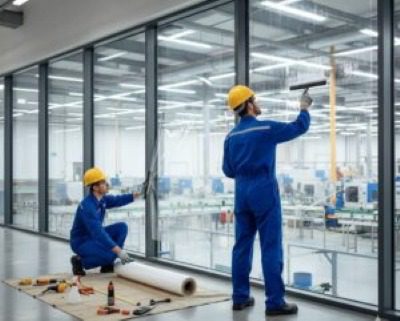
Commercial tinting represents the highest-value segment. Current commercial pricing averages $8 to $20 per square foot nationally, with specialty security films exceeding $20. Commercial jobs frequently surpass $20,000 per project, and the flat glass tinting market is booming as window tinting for businesses gains traction among commercial clients increasingly seeking energy-saving solutions for offices.
Additional revenue streams include film removal services, decorative and privacy films, ceramic coatings, and dealership partnerships. These add-ons increase average ticket size and improve overall profitability.
Profit Margin Fundamentals
Understanding margin fundamentals separates profitable operators from struggling businesses.
Gross profit margins in window tinting typically range from 60% to 80% when pricing reflects quality and value. If gross margin falls below 60%, shops are likely underpricing and losing money without realizing it. High-quality film represents only a fraction of job cost—often $25 to $120 per vehicle—meaning the markup on materials can reach 10x or more.
Net profit margins after all overhead, payroll, and expenses typically stabilize at 15-20% for mature independent operations. Premium shops specializing in commercial or security film installations can achieve higher margins when overhead and risk are managed properly.
The relationship between service mix and profitability is critical. The most powerful lever for boosting profitability is strategically shifting the service mix toward higher-value residential and commercial jobs, rather than just raising prices or cutting material costs. These segments command hourly rates of $95 to $110 compared to lower rates for routine automotive work.
Key Profitability Factors
Moving from margin fundamentals to specific financial drivers, three categories determine whether a window tinting business thrives or struggles: initial investment, revenue per job, and ongoing operating expenses. When considering working capital, it’s important to recognize that there is a critical point—often a silent failure point—where mismanagement or insufficient working capital can lead to business failure if not addressed promptly.
Startup Costs and Investment Requirements
Startup costs vary dramatically based on business model choice, and understanding how to start a tinting business helps clarify which model best fits your capital and goals.
Mobile service entry requires the lowest capital and is considered a low barrier to entry for entrepreneurs, as it involves minimal initial investment and risk. Starting a mobile business can require as little as $1,500 to $10,000, covering essential gear including professional-grade heat guns, squeegees, and knives, plus starter film inventory and basic licensing. Many entrepreneurs can start without a storefront, which significantly reduces overhead costs compared to traditional businesses, especially when following mobile franchise business opportunities that streamline launch and operations. A reliable cargo van for mobile service often has a budget of around $35,000 if bought new or slightly used.
Fixed shop operations demand substantially more capital. Building out a dedicated physical facility typically requires $30,000 to $50,000 or more. Brick-and-mortar locations require higher upfront capital for facility fit-outs and rent deposits, typically starting at $30,000. The initial startup capital expenditure for a comprehensive window tinting business is approximately $82,500, which includes essential equipment like a cutting plotter and a service van, so many entrepreneurs explore buying a window tinting business instead of building from scratch.
For franchise models, franchisees often pay a technology fee to gain access to essential technology, software, and management systems, which facilitates efficient business operation from the start.
Working capital considerations: It is recommended to have $3,000 to $5,000 in working capital to cover initial operating costs. Fixed overhead for many small shops averages around $4,250 monthly, meaning businesses need runway to cover expenses before revenue ramps. Successful lean business models can reach operational breakeven in approximately 7 months.
Revenue Per Job Analysis
Understanding revenue potential across service types enables accurate financial planning. When precise data is not available, it is important to estimate ranges for costs, staffing needs, and productivity metrics, and to update these estimates regularly to manage scaling efficiently.
Automotive jobs average $200 to $800 per vehicle. At $375 average, completing three cars daily produces $1,125 daily revenue. Planning and scheduling workload by week helps estimate profit potential and track the number of installations completed per week. Mobile window tint businesses that tint 5 cars per day can potentially generate over $450,000 in annual revenue, demonstrating the volume-driven nature of automotive work.
Residential projects generate $5 to $15 per square foot. Typical home installations range from $1,500 to $8,000 depending on glass area and film selection. The demand for window tinting services is growing as homeowners seek energy-efficient upgrades that reduce glare and lower energy bills.
Commercial contracts command premium pricing at $8 to $20 per square foot, with projects often exceeding $20,000. Large-scale commercial work benefits from economies of scale—lower mobilization costs per square foot and better material volume discounts.
Operating Expenses Breakdown
Controlling expenses determines whether strong revenues translate to strong profits.
Material costs typically represent 15-25% of revenue for standard automotive work. Bulk purchasing and minimizing waste are critical for protecting margins. A digital film plotter is highly recommended for professional shops to reduce film waste and increase speed—plotters cost $2,000 to $8,000 but pay for themselves through efficiency gains.
Labor costs represent the largest expense category for most operations, averaging around 42% of total expenses for many US tint shops. Technician wages, benefits, and payroll taxes accumulate quickly. Efficiency matters enormously—standardizing workflows to reduce job hours increases the number of jobs completed daily without increasing labor costs. Reducing standard job hours improves technician efficiency, increases billable time, and helps optimize full-time work capacity by allowing each technician to complete more jobs per shift. When scaling operations, strategic hiring aligned with job volume and utilization rates is essential to optimize operational efficiency and margins.
Marketing and customer acquisition can consume significant budget in competitive markets. Customer acquisition costs often target $150 per new customer in the early stages. Optimizing digital marketing, building review reputation, and developing referral programs reduce these costs over time.
Insurance and compliance round out major expenses. Liability insurance policies typically cost between $400 and $900 annually for $1M coverage. Regulatory compliance with local VLT laws and film standards prevents costly fines and rework.
Additionally, using software is crucial for increasing efficiency, ensuring consistency, and managing operations effectively within a window tinting business.
Profitability Models and Financial Projections
Building on the expense framework, concrete financial projections illustrate realistic profitability trajectories for different business models.
Independent Shop Unit Economics
Independent operators control their destiny—and their margins—more directly than franchise owners. They can decide their own schedule and pace, allowing for strategic decision-making in business operations.
Year 1 projections (solo operator): A mobile window tint business tinting an average of 3 cars per day can generate over $250,000 in annual revenue. With gross margins around 45-55% and contained overhead, net profit may range from breakeven to 10% as the business establishes customer base and optimizes operations. Established solo shops can reach $270,000+ in annual revenue, particularly when leveraging a home-based window tinting franchise model that reduces facility costs.
Year 2 scaling: Adding a technician and increasing volume to 5+ cars daily pushes revenue toward $450,000+. Net margins improve to 10-18% as fixed costs spread across higher revenue. Window tinting owners who scale beyond a single technician can achieve substantial earnings, with high-performing operations generating over $320,000 in EBITDA by Year 2.
Year 3+ mature operations: Shops reaching $500,000 to $1M+ in revenue with diversified service mix achieve 15-25% net margins. Owner income after covering labor and reinvestment reaches $80,000 to $200,000+ depending on location and scale. Gross margins improve to 55-65% through better pricing, efficiency, and premium film mix.
Premium service model: Shops specializing in ceramic films, security installations, and commercial contracts can command higher margins. Premium film sales now represent approximately 58% of product sales in high-end tint shops, reflecting customer willingness to pay for quality.
Franchise vs Independent Profitability Comparison
Understanding how much it costs to buy a franchise provides important context when evaluating whether a franchise or independent model better fits your capital structure.
Both models offer paths to profitability with different risk-reward profiles.
| Factor | Franchise Model | Independent Model |
|---|---|---|
| Initial Investment | $25,000-$150,000 (including fees) | $15,000-$85,000 |
| Time to Profitability | 6-12 months | 12-24 months |
| Annual Revenue Potential | $250,000-$600,000+ | $250,000-$800,000+ |
| Net Profit Potential | $100,000-$300,000 | $80,000-$400,000+ |
| Ongoing Costs | Royalty fees (5-8% of revenue) | No royalty obligations |
| Risk Level | Lower (proven systems) | Higher (self-directed) |
| Control | Limited by franchise standards | Complete operational control |
| Franchise advantages: Systematized processes, brand recognition, supplier discounts, and marketing support accelerate ramp-up. Franchises often bundle related services (audio, alarms, wraps) that boost average revenue per customer and smooth seasonality, which can materially influence franchise owner salary potential. |
Independent advantages: No ongoing royalty payments, complete pricing control, and flexibility to pivot service mix. Profit potential per shop may be higher after scale, though variance is larger and risk is higher. For those leaning toward franchising instead, evaluating the best franchises to buy in 2025 helps benchmark opportunities against top-performing brands.
The choice depends on your risk tolerance, available capital, and preference for structure versus autonomy.
Common Profitability Challenges and Solutions
Even well-planned window tinting businesses encounter predictable challenges. Anticipating these obstacles and implementing solutions protects profitability.
Seasonal Revenue Fluctuations
Automotive tinting demand peaks in warmer months and slows during winter, creating cash flow volatility for shops dependent on car tinting alone.
Solution: Diversify service mix toward commercial and residential work, which is less weather-dependent. Shifting toward higher-value residential and commercial jobs not only improves margins but also smooths revenue throughout the year. Develop maintenance contracts and partnerships with builders, architects, and property managers for steady year-round income.
High Customer Acquisition Costs
In competitive markets, marketing costs can erode margins quickly. If customer acquisition costs remain high relative to average ticket size, profitability suffers regardless of volume.
Solution: Focus on referral programs and customer retention to reduce marketing spend from $150 toward $120 or less per new customer. A strong pricing strategy includes offering add-on services that can increase the average ticket size—larger tickets make acquisition costs proportionally smaller. Target higher-value commercial clients where lifetime value justifies acquisition investment.
Scaling Labor and Quality Control
Growth introduces new challenges: maintaining install quality across multiple technicians, preventing costly rework, and retaining skilled installers. Redoing a job can consume twice the profit, wasting labor time and materials.
Solution: Implement systematic training programs and quality control processes to minimize rework costs. Shops that depend on the ‘lowest price’ tend to churn customers and attract low-trust buyers—quality-focused operations retain both customers and skilled technicians. Use technology and pre-cut film systems to improve efficiency and maintain margins during growth. Calculate your average contribution margin by subtracting direct costs from your average ticket size, then track this metric rigorously as you scale.
Pricing Strategy Errors
Underpricing destroys profitability faster than almost any other mistake. Busy shops can still lose money if every job is priced below true cost.
Solution: Develop tiered package pricing (standard, carbon, ceramic) that reflects value delivered. Break-even volume is determined by dividing total fixed monthly overhead by average profit per job—know your numbers before setting prices. Charge premium rates for complex vehicles and specialized films. Annual price increases should be standard practice, not exceptional, particularly if you are operating within a structured window tinting franchise system that supports pricing and positioning.
Conclusion and Next Steps
Window tinting is profitable for operators who understand unit economics, control overhead, and strategically build service mix. The data is clear: mobile businesses generating $250,000+ in their first year, established shops reaching $500,000 to $1M+ with 15-20% net margins, and high-performing operations producing $320,000+ in EBITDA by Year 2.
Success requires deliberate execution rather than simply opening doors and hoping for customers.
Immediate action steps:
- Conduct local market research—assess competition, pricing, and demand across automotive, residential, and commercial segments
- Develop a detailed business plan with realistic revenue projections and break-even analysis
- Secure adequate funding: $1,500-$10,000 for lean mobile start, $30,000-$85,000+ for shop-based operations
- Calculate your required break-even volume before setting prices
Next steps for implementation:
- Research equipment options, prioritizing a digital film plotter for waste reduction and speed
- Evaluate training programs to build installation skills and reduce rework
- Analyze location options for maximum profitability if pursuing fixed-location model
- Consider franchise opportunities as a lower-risk path with proven systems and support
The window tinting market continues growing as both residential and commercial property owners seek energy-efficient solutions. Operators who position themselves for premium service, diversified revenue streams, and operational efficiency will capture the strongest returns in this expanding market.
Frequently Asked Questions
How much can I make owning a window tinting business?
Owner earnings vary by scale and execution. Solo mobile operators typically earn $50,000 to $120,000 annually. Mid-size shop owners with 2-3 bays and diversified service mix can generate $400,000 to $800,000 in revenue, with owner income reaching $80,000 to $200,000+ after expenses. High-performing operations with commercial focus have achieved over $320,000 in EBITDA by Year 2.
What are the startup costs for a profitable window tinting business?
Starting a mobile window tinting business can require as little as $1,500 to $10,000 for tools, training, and marketing—manageable startup costs for most entrepreneurs. Fixed shop operations require more capital: building out a dedicated facility typically requires $30,000 to $50,000 or more, with comprehensive setups reaching $82,500 including cutting plotter and service van.
How long does it take for a window tinting business to become profitable?
Successful lean business models can reach operational breakeven in approximately 7 months. Franchise operations typically achieve profitability in 6-12 months due to established systems and brand recognition. Independent fixed-location shops may require 12-24 months to reach stable profitability depending on market conditions and execution quality.
Is automotive or commercial tinting more profitable?
Commercial and residential tinting generally deliver higher returns per square foot and per hour of labor than standard automotive work. Automotive provides higher volume but lower average tickets. The most profitable operators maintain balanced service mix—using automotive volume to cover fixed costs while commercial and residential jobs boost margins. Shifting service mix toward higher-value commercial jobs is the most powerful lever for profitability.
What profit margins should I expect in window tinting?
Gross profit margins typically range from 60% to 80% when pricing reflects quality and value. Net profit margins after all overhead and expenses stabilize at 15-20% for mature independent operations. Premium specialists in commercial or security film installations can achieve higher net margins with proper overhead management.
Should I start independently or buy a franchise for better profitability?
Both models offer viable paths to profitability. Franchises provide faster ramp-up, proven systems, brand recognition, and support—with typical investment of $25,000 to $150,000 including fees. Independent operations require $15,000 to $85,000 startup but retain more profit after scale through avoiding royalty payments. Choice depends on your risk tolerance, available capital, and preference for structure versus autonomy.