Table of Contents
This guide focuses on residential solar control and window film franchise opportunities-not rooftop solar panel installation.
Why Residential Solar Control Is a Smart Franchise Move in 2026
Between 2024 and 2026, record summer temperatures and climbing electricity prices pushed millions of homeowners to seek faster, lower-cost ways to cool their homes. Residential solar control-window films, tinting, and surface solutions that reduce heat gain, glare, and UV exposure-has emerged as one of the most accessible energy-efficiency upgrades available. It’s not rooftop solar energy; it’s a complementary path within the broader renewable energy movement that modifies incoming solar power rather than harvesting it.
For entrepreneurs evaluating a residential solar control franchise opportunity, the appeal is clear. A home-based, mobile service solar business requires significantly less capital than traditional solar panel franchise models or storefront tint shops. Solar franchises can reduce startup risks compared to independent businesses by providing branding, training, and operational systems from day one. And the underlying demand for energy efficiency and comfort upgrades continues to grow.
In this guide, you’ll learn how the franchise model works for solar control and window film, what typical initial investment ranges and earning potential look like, how day-to-day operations run for a home-based solar business, and how training, a supportive network, and ongoing support reduce the risk of going it alone.

Residential Solar Control vs. Traditional Solar Franchises
When most people hear “solar franchise,” they picture rooftop solar installations-crews hoisting solar panels onto a roof, running conduit, and connecting inverters. Traditional solar franchises offer installation of solar panel systems, and the solar energy industry has boomed as solar panel costs have decreased by 70% over the past decade. Energy storage solutions now allow customers to store excess solar energy, expanding the value proposition further.
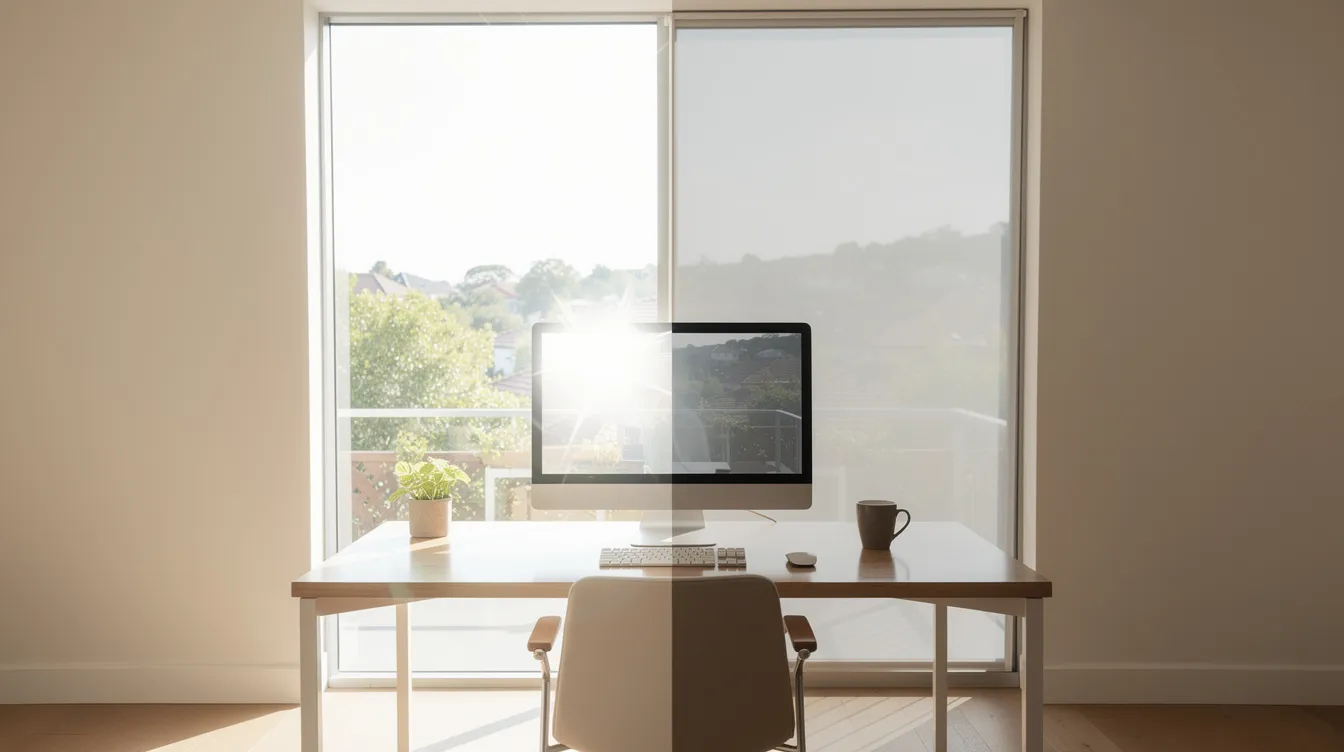
But residential solar control occupies a different and often overlooked niche. Instead of generating electricity, solar control window films cut heat gain by up to 75%, block up to 99% of UV radiation, and reduce annual cooling costs by 10–20% for homes with significant south- or west-facing glass. The work requires fewer licenses and permits than photovoltaic installation, individual projects take hours rather than days, and the initial investment is a fraction of what a rooftop solar company demands.
Here’s how the two paths compare in practical terms:
- Complexity and permitting: Window film installation rarely requires electrical permits or structural engineering reviews. Rooftop solar installations typically require both.
- Installation time: A full-home window film job finishes in a single day. A residential solar system installation often spans two to five days.
- Client education: Solar control customers need to understand heat rejection metrics and film aesthetics. Solar energy generation customers need to understand payback periods, net metering, and utility companies’ interconnection rules.
A strong brand can provide credibility and customer trust in the residential market, and solar franchises benefit from established brand recognition whether you’re in the solar control or solar panel space, especially when you focus on high-profit, proven franchise opportunities. The difference is that window film entrepreneurs can enter the competitive solar market with far less overhead and still serve both residential and commercial clients looking for immediate comfort and savings.
Market Outlook: Demand for Residential Solar Control and Energy Efficiency
The solar market is a $50 billion industry with 50% yearly growth globally, and the solar industry is projected to grow at 15–18% CAGR through 2030. But these numbers extend well beyond rooftop panels. The market for residential energy-efficiency and solar solutions has a strong growth trajectory that encompasses window films, shading, and smart glass technologies.
In the U.S. alone, the residential window film market generated approximately $3.35 billion in 2025 and is projected to reach $5.31 billion by 2033 at a 6.1% CAGR, underscoring how a proven franchise business model in a booming industry can ride this demand wave. Demand for energy efficiency is driven by rising utility costs and sustainability focus-two forces that show no signs of slowing. Solar installations increased by 33% annually over the last decade, and complementary efficiency measures like window film have ridden the same wave. The solar market is labeled as recession-proof due to constant energy demand, which benefits solar control franchises just as much as it benefits rooftop installers.
Several residential segments drive recurring market demand:
- Existing homes with large west- and south-facing glass – these are the highest-impact retrofits, where homeowners see immediate cooling bill reductions
- New construction – builders increasingly spec larger window packages, creating built-in demand for aftermarket solar control
- Remote workers – the home office boom means more people need glare control on screens during peak sun hours
- Government incentives – federal and state programs continue encouraging energy-efficiency retrofits, making it easier for homeowners to justify the expense
Internationally, the Indian solar market is projected to grow at 15–18% CAGR through 2030, and India aims for 500 GW of renewable energy capacity by 2030, signaling that solar control and renewable energy solutions are a global growth story. This steady, non-cyclical demand creates a strong foundation for a home-based solar franchise model focused on window film and surface enhancement.
How the Residential Solar Control Franchise Model Works
A franchise model in residential solar control works similarly to other home-service franchises: the franchisor provides brand recognition, systems, and support, while franchise partners handle local sales, consultations, and on-site installation using mobile service units. Franchising provides a proven operational blueprint and structured training, meaning you don’t have to build a brand, develop processes, or negotiate vendor relationships from scratch.
Here’s how the structure typically breaks down. The franchisor handles national marketing campaigns, product research and development, vendor negotiations, and technology platforms. Franchise networks typically have pre-negotiated wholesale pricing and reliable supply chains, so franchisees access high-performance films, adhesives, and tools at competitive costs without the headache of managing multiple supplier relationships. Franchisees receive operational guidance through detailed manuals and best practices covering everything from quoting to installation to follow-up.
At the local level, franchise owners run consultations, measure glass, present film samples, build proposals, and complete installations. Most systems use standardized pricing frameworks and shared CRM tools for quoting, product ordering, and job management within the franchise network. Solar franchises also provide financing options to lower customer entry costs, making it easier for homeowners to say yes to larger projects.
Protected or semi-exclusive territories-defined by ZIP code, postal code, or population count-prevent franchise partners from competing against each other for the same leads, and many systems also spell out these protections and incentives in detailed franchise FAQs covering territories, costs, and support. This territorial clarity is one of the biggest advantages over going independent, where you’d compete with every local tint shop and online DIY retailer. The availability of attractive financing impacts sales in the residential solar market, so franchisors that offer payment plans or lender partnerships give their owners a measurable edge in closing deals.
This proven business model removes many of the challenges typical of starting a standalone window film or solar energy company: building brand awareness, developing a marketing strategy, trial-and-error with vendors, creating training content, and designing operational processes.
Investment, Costs, and Revenue Potential
Starting a solar franchise requires an investment of $30,000 to $150,000 depending on the model, territory, and service scope, and it’s essential to understand the full CoolVu franchise investment and cost structure before you commit. For a home-based residential solar control franchise, expect your initial investment to land in the $45,000–$90,000 range. Here’s where that money typically goes:
- Franchise fee and onboarding: Training, launch kit, initial territory rights – often $40,000–$75,000
- Vehicle, tools, and equipment: Ladder systems, safety gear, film application tools, vehicle wrap – $5,000–$15,000
- Starter inventory: Ceramic, decorative, safety, and smart film rolls – $2,000–$5,000
- Insurance and licensing: General liability, business registration, and any required local contractor licensing
- Initial marketing: Local digital ads, printed materials, and signage – $2,000–$5,000
Ongoing operational costs include royalty or service fees (typically a percentage of gross sales), monthly software and CRM tools, fuel, materials replenishment, and optional helper or installer labor. Solar franchise fees and royalties can cut into profit margins, so it’s important to model these costs against your projected revenue before signing.
In a realistic revenue scenario, a franchise owner completing 8–12 residential projects per month at an average ticket of $900–$1,500 generates roughly $115,000–$170,000 annually before expenses—figures that align with why many see CoolVu as a top franchise opportunity in the current market. Adding two to three light commercial jobs per month-storefronts, clinics, small offices-can push annual revenue well above $200,000. After expenses, owner earnings in a mature territory often reach $60,000–$100,000 or more.
Annual profits for solar franchises vary based on location and demand. A densely populated Sun Belt territory will generate more leads than a rural northern market, and your personal sales effort and marketing consistency play enormous roles. Setup costs for a home-based model remain dramatically lower than capital-intensive panel installation operations, which often require warehousing, specialized vehicles, and licensed electricians. That lower barrier means a faster path to a profitable business.

Training, Support, and Day-to-Day Operations
Finding trained installers is a challenge within the residential solar control industry, which is exactly why strong training programs and support systems matter so much in any solar franchise or window film franchise, and why many owners highlight CoolVu’s supportive franchise experience as a major advantage. High-quality window film installation requires skilled labor and thorough training-poor application leads to bubbling, peeling, and unhappy customers.
Comprehensive training programs cover installation processes and customer service, backed by an experienced CoolVu leadership and franchise support team that understands the window film industry inside and out. A typical residential solar control franchise provides initial hands-on training spanning 40–65 hours, combining classroom instruction with live installation practice on solar control films, security film, decorative graphics, and basic ladder and glass safety. Franchisors provide ongoing support through technical training and sales guidance, including virtual sales workshops, quoting software walkthroughs, and consultative home-visit techniques. Franchisors also provide ongoing training on new technologies and sales tactics as product lines evolve-smart switchable films, advanced ceramic coatings, and architectural surface finishes.
Here’s what a typical day looks like for a residential solar control franchise owner:
- Morning: Review and respond to leads from digital campaigns and referrals, confirm day’s appointments, load vehicle with materials
- Midday: Perform in-home consultations-measure glass, present film samples, discuss performance metrics like heat rejection and visible light transmission, build proposals on-site
- Afternoon: Complete installations or supervise installers, document work with photos, collect final payment
- End of day: Update CRM, request customer reviews, schedule follow-ups and next-day appointments
Franchisors offer access to proven marketing strategies and campaigns, including social media templates, branded web presence, and lead funnel optimization. Phone or chat access to technical support handles challenging installations-unusual glass types, curved surfaces, or thermal stress concerns. And peer-to-peer support within the franchise network, such as regional meet-ups or online groups, gives franchise owners a collaborative community for sharing best practices and real-world business experience.
Services You Can Offer Under a Residential Solar Control Franchise
Diversification of services increases revenue per customer and smooths seasonal gaps, and it’s one of the top considerations when evaluating a window tinting franchise with multi-service offerings. Some franchises allow cross-selling into commercial buildings and decorative window graphics, which dramatically expands your addressable market. Here’s what a typical service menu includes.
Core residential solar control services:
- Heat-rejection and glare-reducing window films for living rooms, bedrooms, and home offices-imagine retrofitting a 1980s suburban home with large south-facing sliders that are turning the family room into a greenhouse every afternoon
- UV-blocking films to protect flooring, artwork, and furnishings from fading (up to 99% UV rejection)
- Privacy and one-way reflective films for street-facing windows
Complementary service lines:
- Safety and security films for homes in storm-prone areas or neighborhoods concerned about forced entry
- Decorative films and wall graphics for bathrooms, glass doors, and interior partitions
- Architectural surface finishes that refresh cabinets, doors, and interior surfaces without full replacement
Maintenance services include routine inspections and system performance monitoring for previously installed films, generating repeat business and recurring revenue through maintenance and servicing offerings—core strengths of a home-based window tinting and surface solutions franchise. Energy audits assess current consumption and identify savings potential, positioning you as a trusted advisor rather than just an installer. Adding light commercial solar control-retail storefronts, clinics, schools-allows franchise partners to serve both residential and commercial clients and grow beyond purely residential work.
Consider the home office example: a remote worker with east-facing windows dealing with brutal morning glare on dual monitors. A spectrally selective film with high visible light transmission but strong solar heat rejection solves the problem in under two hours. That’s a $400–$800 job that generates a five-star review and a referral to the neighbor.
What to Consider Before You Buy a Solar Control Franchise
Choosing the right solar franchise or window film brand is critical for long term success. Franchise systems should be compared based on initial fees, royalties, and support-not just the lowest price tag.
Key evaluation factors—and understanding how to become a CoolVu franchise owner from inquiry to launch—will shape whether a particular system is the right fit for you:
- Total investment and working capital – Can you cover initial franchise fees plus 6–12 months of operating expenses before the business sustains itself?
- Territory size and lead handling – Identifying territory opportunities is crucial for residential solar control franchises. Ask how overlapping leads are managed and whether territories are truly protected.
- Product quality and warranties – What films and finishes does the franchisor supply? What are the performance specs and manufacturer warranties?
- Support responsiveness – How quickly can you reach someone when an installation goes sideways?
- Cultural fit – Do the franchisor’s values, communication style, and growth expectations align with yours?
Before signing, ask for Franchise Disclosure Documents, which outline essential details such as fees and brand support. Request contact information for existing franchise partners to get unfiltered feedback. Ask to see sample marketing campaigns, typical lead volumes, and close rates.
Common mistakes to avoid: underestimating customer acquisition costs (customer acquisition for solar franchises can involve significant costs and marketing efforts), ignoring online reviews and reputation management, or focusing purely on the lowest initial investment while overlooking operational support quality. Franchise agreements often come with restrictions limiting local business flexibility, so read the fine print carefully. Residential solar is sensitive to macroeconomic shifts and changes in government incentives, meaning your territory’s economic health matters. The success of solar franchises relies on localized marketing and exceptional customer service-not just the franchisor’s national brand.
Common Questions About Residential Solar Control Franchises
Here are the questions prospective franchise owners ask most often about solar franchise opportunities in the solar control and window film space.
How much does it cost to start a residential solar control franchise?
A realistic 2026 range for a home-based residential solar control franchise is $45,000 to $90,000, covering the franchise fee, vehicle and equipment, starter film inventory, insurance, and launch marketing. Costs move higher with larger territories or if you choose to invest in a dedicated workspace. Starting a solar franchise in the broader solar sector requires an investment of $30,000 to $150,000, but home-based window film models sit at the lower end. Startup costs are substantially less than what a rooftop solar company or storefront tint shop requires.
Do I need prior construction or glazing experience to own this kind of solar business?
No. Many franchise owners come from sales, management, military, or service backgrounds and have zero prior trade experience. Comprehensive training programs cover installation processes, customer service, and safety protocols. What matters more is your comfort with ladders, basic tools, and face-to-face customer interaction. Franchisors design their training to empower entrepreneurs from all walks of life.
How quickly can a solar control franchise become profitable?
Most owners see meaningful revenue within three to six months and reach profitability between six and eighteen months. Franchisees can expect to reach full operational capacity within 3 to 6 months. Key drivers include your territory’s population density, your consistency with marketing campaigns, your sales skills, and your willingness to add commercial projects over time. Annual profits for a solar franchise can vary widely based on location, so territory selection is critical for financial success.
What licenses or permits are required for window film and solar control work?
Requirements differ by state and province. Solar franchise opportunities require compliance with local regulations and permitting standards. Some jurisdictions require a home improvement contractor license; others only need a general business registration. General liability insurance is a baseline expectation everywhere. Check with your local contractor board and municipality before launching, and your franchisor should be able to guide you through requirements for your specific area.
Is there still room in the market with so many solar companies and tint shops?
Absolutely. The growing market for energy efficiency means demand isn’t a zero-sum game. A professional franchise model with an established brand, multi-service offerings, and a structured sales process can attract customers that solo installers and generic tint shops simply can’t reach. Brand recognition, consistent quality control, and excellent customer service separate franchise operations from the fragmented competition. The solar energy market and energy-efficiency retrofit market both continue expanding.
Can I run this franchise part-time or alongside another business?
While some owners ease in gradually, the best results come from treating this as a primary, full-time solar business-especially during the first one to two years of business growth. Customer responsiveness and consistent marketing efforts drive early momentum. Part-time involvement can work during ramp-up, but you’ll need to maintain control of lead follow-up, scheduling, and customer satisfaction to build the reputation that fuels long term success.
How does residential solar control complement rooftop solar energy systems?
They’re natural partners. Window films reduce the cooling load a home’s HVAC system carries, which means rooftop solar panels can offset a larger percentage of total energy use. Homeowners who install solar control film first often need fewer solar panels or a smaller solar system to achieve net-zero goals. Some franchise owners build referral relationships with local solar installers for mutual benefit.
What kind of support do I get with digital marketing and lead generation?
Most solar control franchisors provide marketing support including a branded website presence, local SEO optimization, social media templates, marketing materials, and paid digital advertising management. Franchisees access centralized lead funnels, and the franchisor typically handles national-level campaigns while coaching you on local outreach. This marketing support is one of the strongest reasons to choose a franchise over going independent, where you’d build everything from scratch.
Why Choose Our Residential Solar Control Franchise
CoolVu offers a modern, home-based alternative to capital-heavy solar panel franchise operations and traditional storefront tint shops. With over 100 franchise locations launched in under four years, our robust business model is built for entrepreneurs who want a lower risk entry into a growing market with a reputable brand behind them.
What makes CoolVu different:
- Home-based, mobile service model with low overhead and no showroom requirement
- Comprehensive training across solar control films, decorative graphics, security film, smart switchable films, and architectural surface finishes
- Access to in-house financing options and preferred lender relationships for qualified franchise partners
- Protected territories designed to balance opportunity and manageable travel time
- High quality products sourced through a centralized dealer network with pre-negotiated pricing
Our franchise network supports owners with centralized digital marketing, branded web presence, and lead funnel optimization. We invest in ongoing product innovation-smart films, advanced ceramic coatings, architectural surface finishes-to keep our franchise owners ahead of the competitive solar market. Our collaborative culture prioritizes sharing success stories and operational guidelines that help every owner streamline operations and close deals faster.
CoolVu is focused on practical, profitable residential and light commercial projects. We’re here to help you build a real, sustainable business-not chase speculative renewable energy experiments.
Next Steps: How to Explore This Franchise Opportunity
If the residential solar control franchise model aligns with your goals, moving from research to action is straightforward. Start by requesting an information packet or completing an online inquiry form. From there, schedule an introductory call to review territory availability and fit. Review the Franchise Disclosure Document with a qualified advisor. Speak with existing franchisees about their experience and results. Attend a virtual or in-person discovery day to see operations firsthand. Then finalize your territory selection, funding, and launch timeline.
Now-amid strong interest in renewable energy, clean energy, and energy efficiency across the solar industry-is an advantageous time to enter this growing market with a proven franchise model. Contact the CoolVu franchise team today to check territory availability in your area and take the first step toward owning a positive impact business built for 2026 and beyond.